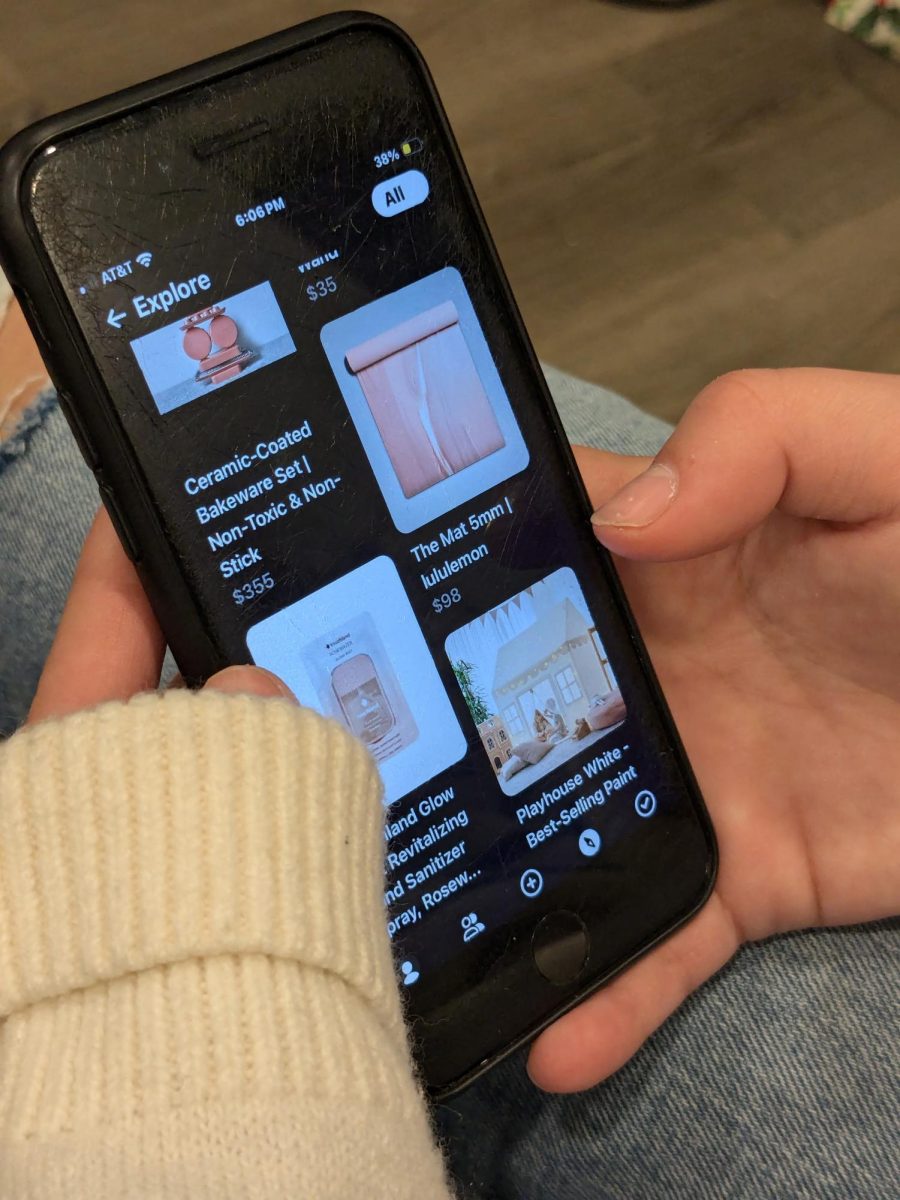
When you think of shopping, what comes to mind? Do you picture browsing up and down store aisles, or scrolling on a phone screen at home? For more and more Americans, the answer is the second.
“You have all of the stuff right at your fingertips, like on your phone or on your computer, instead of actually having to drive over to the store,” junior Mason Bauer said.
Online shopping has surged in recent years, with behemoths like Amazon leading the charge. According to a Capital One Shopping Research report, annual sales from e-commerce platforms hit $1.34 trillion in 2024, more than tripling sales from just 10 years prior.
So, how did we get here?
The online shopping boom didn’t happen overnight. Born in the 90’s, the concept of shopping online started to really take hold in the 2000s. As the internet became more widely accessible, e-commerce grew from CDs and books to regular household items. New web-based marketplaces like Amazon and eBay positioned themselves as alternatives to driving to a store. Many in-person retailers started to follow suit, creating online storefronts to complement their physical locations.
Going into the 2010s, online shopping continued its growth due to its convenience, wider range of selection, and shorter shipping times. CHS Economics teacher Colin Heminway weighed in on online shopping and its large-scale growth.
“I would say Amazon has made the role of the consumer much easier. We don’t need to get in our car and go somewhere. As a consumer, you’d be foolish to not take advantage of what Amazon offers you,” Heminway said.
The real turning point, however, was COVID. Lockdowns due to the COVID-19 pandemic forced people to stay at home instead of going out to stores. This led to a huge shift towards e-commerce, as it became not only the convenient choice, but the safe one, too. Americans relied on websites and apps for the everyday necessities they would typically go out for, from groceries to household essentials.
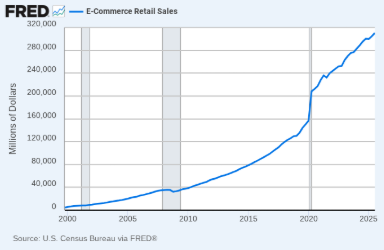
(Source: U.S. Census Bureau via FRED®)
That brings us to today. Post-COVID, a lot of changes stuck. E-commerce kept on growing across multiple fronts. While services like DoorDash dominate the food delivery market, new “fast fashion” sites like SHEIN and Temu have disrupted the fashion industry. Online shopping is bigger than ever, and still continuing to evolve.
Much of this continued growth comes down to one key factor: convenience.
“I like convenience. I think most people do. You can get something and you know it’ll be here tomorrow,” CHS French teacher Keith Kesten remarked.
As great as this convenience is, it comes at a cost. Once a staple of the American retail scene, malls have seen a steady decline since the advent of online shopping. Take the Moorestown Mall as an example. In 2000, the Moorestown Mall featured 120 stores, yet it stands today with a quarter of those stores shuttered. This includes former department store giants like Macy’s, Sears, and Lord & Taylor, as well as clothing stores like American Eagle, Hollister, and Gap.
This trend goes beyond just our area. Nationwide, malls have been steadily dying out in recent years. According to Capital One Shopping Research, the number of malls in the US fell by over 15% from 2017 to 2022, with another 25% of malls expected to close by 2028.
“It’s definitely going to be an ‘if you’re not online, you’re not going to be successful’ type of situation,” Heminway said. “I can see a lot of malls going out of business because there’s no incentive to have physical locations anymore.”
Enter the concept of the “third place,” first introduced by American sociologist Ray Oldenburg in his 1989 book, The Great Good Place. A third place is a social space where people can go outside of their home, school, or place of work. These spaces offer social interaction with other people, encouraging connection and conversation. Some examples of third places include cafés, diners, community centers, libraries, parks, and most notably, malls.
The slow decline of malls has taken away a critical third place for teenagers to hang out and engage socially. Even some malls that are still open, like the Moorestown Mall, are far from their former selves. They stand as half-occupied spaces with low foot traffic, devoid of the bustling social scene of times gone by. Without malls to serve as a third place for teens, many Gen Z’ers are left with fewer opportunities for in-person social interaction.
Heminway reminisced about a time when online shopping hadn’t sidelined the mall.
“I went to the mall just to go hang out,” he noted. “It encouraged loitering in a sense, where you could go and just hang out and meet people and all those sorts of things.”
The bell hasn’t tolled for malls just yet though, and Gen Z still has an opportunity to breathe new life into their quiet halls. IPX1031, a Philadelphia-based real estate investment firm, reports that 61% of Americans wish malls would have a revival. Gen Z polled the highest out of all generations surveyed.
Repeating this sentiment, Bauer noted that he wishes there were more third places like the mall to socialize at in our area.
“I think we have a couple of them around Cinnaminson, because I know you can do that at Starbucks, but I feel like that’s one of the only places that you can really just sit and hang out,” Bauer said. “I feel like there should be more.”
In the end, the responsibility falls on us as consumers to decide where we are going to spend our money. Malls need revenue to stay in business, and that revenue will come when we do. If consumers can put their money where their mouths are, we could potentially see a comeback for malls–and third places as a whole–in the coming years. The sentiment is already there.
“We need to socialize with human beings, and we need to relearn how to socialize with human beings,” Heminway said.
This doesn’t mean cutting out online shopping entirely, but rather, shopping online on top of supporting in-person businesses from time to time. Consumers can enjoy getting a package the day after hitting the “buy” button as well as taking time to socialize and talk to people at third places like the mall. The key will be finding a healthy balance between the two, and ultimately, Gen Z’s decision on this will shape how we will shop in the future.